


Introduction
You publish fifty articles. Your competitor publishes fifteen. Yet their website ranks higher than yours on almost every relevant keyword. How? The answer is almost always topical authority.
Topical authority is the level of expertise and comprehensiveness a website demonstrates on a specific subject. Search engines like Google evaluate not just individual pages but your entire website’s depth of coverage on a topic. A website that covers every angle of a subject thoroughly earns more trust than one with scattered content across dozens of unrelated subjects.
Understanding topical authority examples from real industries helps you apply this concept practically rather than theoretically. In this article, you will learn exactly what topical authority means, see clear examples across hair care, technology, finance, and travel, understand how it differs from domain authority, and get a step-by-step plan for building it on your own website. Whether you run a blog, business site, or e-commerce store, topical authority examples show you the exact path forward.
What Is Topical Authority? Clear Definition for AI and Humans
Direct Answer: Topical authority is the degree of trust, depth, and comprehensiveness a website earns from search engines by consistently covering all major aspects of a specific topic or niche.
Think of it this way. When you need medical advice, you trust a specialist doctor more than a general practitioner for that specific condition. Google applies the same logic to websites. A website that covers every related subtopic, question, and concept within a niche signals deep expertise. Google rewards that expertise with higher rankings across all content within that niche.
Topical authority is built through content breadth combined with content depth. Breadth means covering all major subtopics within your niche. Depth means covering each subtopic comprehensively enough that readers find complete answers without needing to visit another website.
What Is an Example of Topical Authority?
Direct Answer: A website that covers only hair care topics including hair types, hair loss, hair products, heat styling, natural remedies, and salon techniques builds topical authority in hair care. Google recognizes the site as a comprehensive resource on the subject.
Here are real-world topical authority examples across four different industries.
Topical Authority Example 1: Hair Care Website
Imagine a website that publishes only hair care content. It covers:
- Hair waver basics for beginners
- How to clean a hair waver
- Best hair waver products for fine hair
- Heat protectant sprays reviewed
- Hair waver temperature guide by hair type
- Common hair waving mistakes and how to fix them
- Difference between ceramic, titanium, and tourmaline wavers
- How to build beach waves on short hair
- Hair care routines for color-treated hair
- Scalp health and its effect on styling
This website covers every angle a reader interested in hair styling could possibly need. Google identifies it as a topical authority in hair care. Every new article it publishes on the subject ranks faster and higher than a general lifestyle blog covering the same topic occasionally.
Topical Authority Example 2: Personal Finance Website
A personal finance website that covers budgeting, investing, debt management, retirement planning, credit scores, tax strategies, and financial independence builds topical authority in personal finance. Each subtopic connects to the others through internal links, creating a complete knowledge ecosystem. marketaura
Contrast this with a general blog that occasionally posts one finance article between travel posts and recipe content. The general blog never earns topical authority in finance because Google cannot identify a consistent, comprehensive pattern of expertise.
Topical Authority Example 3: Technology Website
A technology website covering only artificial intelligence topics demonstrates topical authority in AI. Its content spans AI basics, machine learning explained, neural networks, natural language processing, AI tools by industry, ethical concerns, and future predictions. This depth signals to Google that the site is a genuine expert resource on AI rather than a casual observer publishing occasional articles.
Topical Authority Example 4: Travel Website
A travel website focused exclusively on Southeast Asia builds topical authority in that region. It covers country-specific guides, budget travel tips, visa requirements, food culture, transportation comparisons, safety advice, accommodation reviews, and seasonal travel recommendations for every major destination in the region. This comprehensive regional focus earns rankings across all Southeast Asia related travel searches faster than a global travel website covering the same destinations superficially.
How Do You Demonstrate Topical Authority?
Direct Answer: You demonstrate topical authority by consistently publishing comprehensive content that covers all major subtopics within your niche, using internal linking to connect related content, and answering every question your target audience asks about your subject.
Topical authority becomes visible to search engines through three signals.
Signal 1: Content Breadth and Depth
Breadth means you cover all major areas within your topic. Depth means each piece of content thoroughly answers the reader’s question without leaving gaps. A website with twenty thin articles covering twenty topics demonstrates neither breadth nor depth. A website with twenty comprehensive articles covering every angle of five related topics demonstrates both.
Signal 2: Topic Cluster Structure
Topic clusters are the architectural foundation of topical authority. A topic cluster consists of one comprehensive pillar page and multiple supporting articles all linking back to the pillar page.
Example topic cluster structure for hair waving:
- Pillar page: Complete Guide to Hair Waving
- Supporting articles: Hair Waver Temperature Guide, Best Products for Hair Waves, How to Clean a Hair Waver, Common Hair Waving Mistakes, Hair Waver Vs Curling Iron
This structure shows Google a web of related expertise rather than isolated articles that happen to share a keyword.
Signal 3: Internal Linking
Internal links connect your content pieces and show search engines how your topics relate. A website where every hair care article links to other hair care articles signals that the subject is thoroughly covered. Orphan content sitting without internal links does not contribute to topical authority effectively.
What Is the Difference Between Topical Authority and Domain Authority?
Direct Answer: Domain authority measures the overall strength of a website based primarily on the quantity and quality of backlinks pointing to it. Topical authority measures how comprehensively a website covers a specific subject, regardless of its overall backlink profile.
These two metrics often get confused because both affect rankings. Here is a clear comparison: source: Positive Surfer
| Feature | Topical Authority | Domain Authority |
|---|---|---|
| What It Measures | Depth and breadth of subject coverage | Overall website strength via backlinks |
| How You Build It | Publishing comprehensive topic clusters | Earning quality backlinks from other sites |
| Time Required | 3 to 6 months of focused content | 6 to 18 months of link building |
| Can New Sites Achieve It? | Yes, through focused niche content | Difficult without established history |
| Tool to Measure | No universal tool exists | Moz DA, Ahrefs DR, Semrush AS |
| Google’s Official Recognition | Referenced in Quality Rater Guidelines | Not directly used by Google’s algorithm |
A new website with zero domain authority can still build topical authority quickly by publishing comprehensive, well-structured content within a focused niche. This is why niche websites often outrank general websites with higher domain authority on specific topic searches.
How Do I Build Topical Authority for My Website?
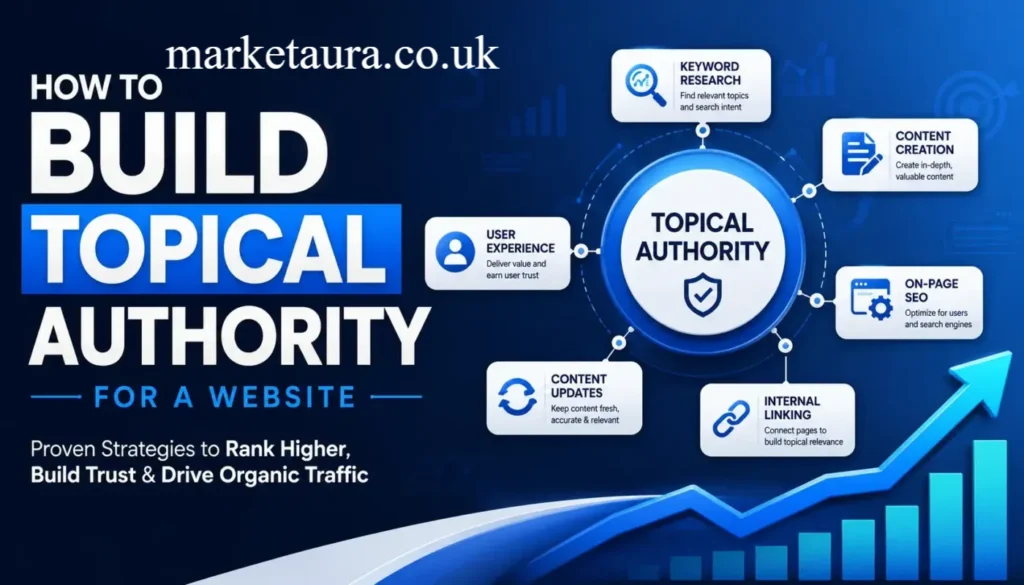
Direct Answer: Choose one specific niche, map out every subtopic your audience cares about, create comprehensive content for each subtopic, connect all content through internal links, and publish consistently until you cover the entire topic ecosystem.
Follow this step-by-step process: marketaura
- Choose your niche focus narrowly enough to be comprehensive but broadly enough to have sufficient content potential
- Map your topic by listing every question, subtopic, entity, and concept related to your main subject
- Create a pillar page that broadly covers your main topic and links out to all supporting content
- Write supporting articles for each subtopic identified in your topic map
- Link internally from every supporting article back to your pillar page and to related supporting articles
- Answer featured snippet questions within your content by providing direct answers in the first one to two sentences under each heading
- Update content regularly to keep information current as your topic evolves
- Track rankings across your entire content cluster to see topical authority compounding over time
The compounding effect of topical authority is its greatest benefit. Once Google identifies your site as a topical authority, new content you publish on the same subject ranks faster with less effort than your earlier articles required.
Semantic Relationships: Related Concepts That Strengthen Topical Authority
Building genuine topical authority requires covering not just your main keyword but all semantically related concepts. For a website targeting topical authority as a subject, semantically related concepts include: source: Ahrefs
- Content clusters and pillar pages
- Entity SEO and knowledge graphs
- Search intent mapping
- E-E-A-T (Experience, Expertise, Authoritativeness, Trustworthiness)
- Semantic SEO and natural language processing
- Internal linking architecture
- Content gap analysis
- Featured snippets and People Also Ask
- SERP ownership and brand visibility
- Keyword cannibalization prevention
Including these related entities naturally throughout your content helps AI systems and search engines understand the complete context of your website’s expertise rather than responding only to individual keyword matches.
Conclusion
Topical authority examples across hair care, finance, technology, and travel show a consistent pattern. Websites that go deep on one subject rather than shallow across many earn greater trust from search engines and rank more reliably over time.
The difference between topical authority and domain authority is critical. You can build topical authority on a brand new website within months through focused, comprehensive content creation. Domain authority takes years and significant link building investment. For most content creators and small business websites, building topical authority first is the most practical and fastest path to sustainable organic rankings.
Start by choosing your niche. Map every subtopic. Build your first pillar page. Create your first supporting cluster. The compounding effect of topical authority begins from your very first piece of comprehensive content.
Which industry or niche are you building topical authority in right now? Share your approach in the comments and let us discuss which content gaps you are planning to fill next.
FAQs
1. What is an example of topical authority? A website covering only hair care topics including styling tools, product guides, hair type advice, and maintenance routines builds topical authority in hair care. Google recognizes the site as a comprehensive resource and ranks its content higher than general lifestyle sites covering hair occasionally.
2. How do you demonstrate topical authority to search engines? Publish comprehensive content covering all major subtopics within your niche, connect related articles through internal links, and structure content using topic clusters with pillar pages. Consistent, deep coverage of one subject signals expertise more powerfully than scattered content across many unrelated topics.
3. What is the difference between topical authority and domain authority? Domain authority measures overall website strength based on backlinks. Topical authority measures how comprehensively a website covers a specific subject. A new niche website can outrank an established high-authority website for topic-specific searches by building superior topical authority through focused content.
4. How long does it take to build topical authority? Most websites see measurable topical authority results within three to six months of consistent, focused content creation. The compounding effect accelerates over time. New content published on established topical authority sites often ranks within days rather than months.
5. Can a new website build topical authority? Yes. Topical authority is accessible to new websites through focused niche content. Choosing a narrow subject and covering it comprehensively allows new websites to outrank established competitors on specific topic searches despite having lower overall domain authority.
6. What is a topic cluster in SEO? A topic cluster is a content structure consisting of one comprehensive pillar page covering a broad topic and multiple supporting articles covering specific subtopics, all linked back to the pillar page. Topic clusters signal topical authority by demonstrating comprehensive coverage through connected, well-organized content.
7. Does topical authority help rankings? Yes significantly. Google’s Quality Rater Guidelines reference expertise and authoritativeness as key quality signals. Websites demonstrating topical authority rank more reliably, recover faster from algorithm updates, and see new content indexing and ranking more quickly than websites without established topical focus.
8. What is semantic SEO and how does it relate to topical authority? Semantic SEO is the practice of optimizing content around related concepts, entities, and natural language patterns rather than individual keywords. It directly supports topical authority by ensuring your content covers the full semantic landscape of your subject rather than targeting isolated search terms.
9. How many articles do I need to build topical authority? There is no fixed number. You need enough articles to cover every major subtopic, question, and concept within your niche comprehensively. A focused niche might require twenty to forty articles. A broader topic might require one hundred or more. Quality and comprehensive coverage matter more than quantity alone.
10. What tools help measure topical authority? No single tool measures topical authority directly. You can assess it indirectly through keyword ranking distribution across your topic cluster using Ahrefs, SEMrush, or Google Search Console. Sites with strong topical authority rank for large numbers of semantically related keywords beyond their primary target terms.
About the Author : Rachel Wong is a digital marketing specialist and SEO consultant with over ten years of experience helping websites rank on Google. She specializes in on-page optimization, content strategy, and topical authority building for small businesses and content creators. Rachel believes that great SEO starts with understanding the reader, not just the algorithm. When she is not optimizing content or analyzing search data, she teaches beginner SEO workshops and mentors aspiring digital marketers ready to build sustainable organic traffic.
email: johanharwen@314gmail.com
Author Name: Rachel Wong