



Introduction
If you have been searching for the SpaceX stock price today, you are not alone. Millions of retail investors are refreshing their screens right now, and for good reason. Tomorrow, June 12, 2026, SpaceX officially begins trading on the Nasdaq under the ticker SPCX at an IPO price of $135 per share. That price tag values the company at roughly $1.75 trillion, making it the largest IPO in history by a wide margin.
This is not just another tech stock launch. This is the moment Elon Musk’s rocket company, after more than two decades of staying stubbornly private, finally opens its doors to everyday investors. Whether you are thinking about buying in, sitting on the sidelines, or simply trying to understand what all the noise is about, this article breaks it all down for you. We cover the current share price, what drives that valuation, the risks you need to know, and how to actually get your hands on shares.
What Is the SpaceX Stock Price Today?
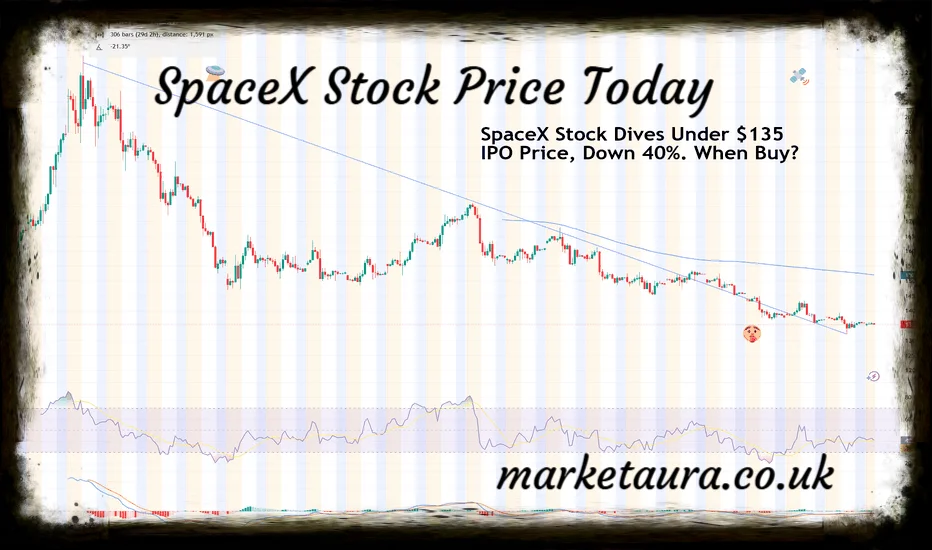
Here is the short answer: SpaceX stock is set to start trading on the Nasdaq on June 12, 2026, under the ticker SPCX, with an expected IPO price of $135 per share and an anticipated market capitalization of $1.75 trillion.
Before the public listing, pre-IPO marketplaces have been showing a range of prices. As of June 11, 2026, the Forge Price for SpaceX sits at $128.84 per share. Meanwhile, Hiive, another pre-IPO marketplace, estimates SpaceX stock at $149.47 per share as of June 11, 2026.
These numbers differ because each platform uses its own pricing model built from secondary market transactions, investor bids, and comparable company data. None of them represent an official public market price. That only happens tomorrow
Why the Price Differences Between Platforms?
You might be wondering why one platform says $128 and another says $149. Private company shares are illiquid. They do not trade on open exchanges, so every valuation estimate is part algorithm, part art. Platforms weigh different data inputs such as confirmed transactions, bids, and institutional marks differently. Once the stock begins trading publicly on Friday, you will have a single, real-time price to track.
Why SpaceX Is Going Public Now
For years, Elon Musk insisted SpaceX would never go public. The concern was always that short-term shareholder pressure would conflict with the company’s long-term mission of making humanity multiplanetary. So what changed?
The answer, in large part, is Starlink.
Though SpaceX was originally pitched as a space exploration company, its most profitable segment is now Starlink, a satellite constellation offering high-speed internet. Starlink recorded an 86% increase in adjusted EBITDA between 2024 and 2025, while its total subscriber base doubled.
That kind of growth makes a compelling case to capital markets. Starlink is essentially a recurring subscription business layered on top of a rocket company, and investors love recurring revenue.
Starlink’s subscriber base and revenue, estimated at 58% of SpaceX’s total revenue in 2024, have become central to the company’s overall valuation story.
SpaceX Financial Performance: The Numbers Behind the Hype
Before you invest a single dollar, you should understand what you are actually buying into. Here is a clear picture of SpaceX’s finances.
Revenue Growth
SpaceX generated $18.7 billion in total revenue for full-year 2025, up from $14.1 billion in 2024. That represents a 33% year-over-year increase. On an adjusted EBITDA basis, the company reported $6.6 billion in profit for 2025.
In the first three months of 2026, revenue rose a further 15% year-over-year. Growth is clearly still accelerating.
The Profitability Picture Is More Complicated
Here is where things get nuanced. SpaceX’s adjusted EBITDA looks strong, but the GAAP numbers tell a different story.
Despite the EBITDA profit, SpaceX posted a GAAP net loss of $4.94 billion for full-year 2025. Q1 2026 accelerated that trend with a $4.28 billion net loss in a single quarter. The accumulated deficit now sits at $41.3 billion.
That gap is driven by heavy spending on Starship development, stock-based compensation, and satellite infrastructure depreciation. These are real costs, even if some are non-cash on the income statement. You need to weigh that honestly before buying.
Government Revenue Dependence
SpaceX generated $5.9 billion from the US government in 2025. NASA, the Department of Defence, and intelligence agencies are the largest customers. That is a meaningful portion of revenue tied to government contracts, which can change with administration priorities or budget cycles.
The $1.75 Trillion Question: Is the Valuation Justified?
This is the question every serious investor is asking right now.
At its targeted share price of $135, SpaceX’s valuation would reach around $1.75 trillion, making it one of the 10 biggest listed companies on Earth. To put that in perspective, that would more than double the record Saudi Aramco set in 2019.
At $1.75 trillion, SpaceX would trade at approximately 94 times sales based on its 2025 revenue. That is an extraordinary multiple. Even the most loved tech companies rarely sustain valuations above 30 to 40 times sales for extended periods.
Defenders of the valuation point to a few things:
- Starlink’s growth trajectory. If Starlink can scale to hundreds of millions of subscribers globally, the addressable market is enormous.
- Starship. A successful heavy-lift rocket changes the economics of launching satellites, cargo, and eventually passengers. Every competitor becomes less relevant overnight.
- xAI integration. In February 2026, SpaceX formally acquired Elon Musk’s artificial intelligence company xAI in an all-stock deal, structuring xAI as a wholly owned subsidiary. The combined private valuation was reported at about $1.25 trillion. The idea behind the acquisition is to link AI development more directly to SpaceX’s satellite and launch capabilities, including visions of space-based AI data centers.
That said, you should not ignore the bear case. The valuation leaves almost no room for disappointment. One bad earnings report, a Starship failure, or a shift in government contracts could send the stock sharply lower.
How to Buy SpaceX Stock on IPO Day
If you want to buy SPCX shares, here is how to do it.
Through Major Brokerages
In its prospectus, SpaceX named Charles Schwab, Fidelity, Robinhood, SoFi, and Morgan Stanley’s E-Trade as some of the brokerage platforms that will make shares available. If you already have an account at one of these platforms, you should be able to buy shares when the stock starts trading on Friday morning.
IPO Allocation vs. Open Market
There is a difference between getting IPO-priced shares at $135 and buying in the open market after trading begins. IPO allocations go to institutional investors and a portion to retail clients who request shares through their brokerages before listing. If you miss the allocation, you simply buy at whatever the market price is once trading opens. That price could be higher or lower than $135 within minutes of the open.
A Word of Caution
Rodney Comegys, chief investment officer at Vanguard Capital Management, advises caution for retail investors. He notes that investing in an IPO process can be highly speculative, and it is difficult to determine the path of an IPO on a given day.
That is not advice to avoid the stock entirely. It is advice to size your position appropriately and not bet the farm on day-one momentum.
SpaceX vs. Competitors: How Does It Stack Up?
Understanding where SpaceX sits relative to the broader aerospace and tech landscape helps you put the valuation in context.
| Company | Market Cap (approx.) | Primary Business |
|---|---|---|
| SpaceX (SPCX) | $1.75T (IPO target) | Rockets + Satellite Internet |
| Boeing | ~$100B | Commercial & Defense Aviation |
| Lockheed Martin | ~$130B | Defense Systems |
| Amazon (Kuiper) | Part of ~$2T | Satellite Internet (not separate) |
| OneWeb (Eutelsat) | ~$1B | Satellite Internet |
SpaceX dwarfs every traditional aerospace competitor. Its closest rival in satellite internet, Amazon’s Kuiper project, is not even publicly traded as a standalone entity. The lack of direct listed comparables makes valuation tricky, which is both an opportunity and a risk.
Key Risks You Should Not Ignore
Buying into any IPO carries risk. Buying into the largest IPO in history carries outsized risk. Here are the ones that matter most.
Starship is not yet proven at scale. The entire Starlink Gen 2 constellation depends on Starship working reliably. A major failure during or shortly after the IPO would hammer the stock price.
The valuation multiple is aggressive. At 94 times sales, there is very little margin for error in the growth story. Any slowdown in Starlink subscriber growth or launch revenue could trigger a significant re-rating.
Government contract dependency. A large share of revenue comes from US government agencies. Policy changes, budget cuts, or geopolitical shifts could affect this materially.
GAAP losses are accelerating. The accumulated deficit now sits at $41.3 billion, with a $4.28 billion loss in a single quarter in early 2026. Cash burn at this scale is manageable only as long as growth stays robust.
Elon Musk concentration risk. SpaceX is deeply tied to Musk’s vision, leadership, and public profile. His other ventures, including Tesla and X, can influence public sentiment toward everything he touches.
What Analysts Are Saying About SpaceX Stock Price
Wall Street’s reaction has been broadly enthusiastic, though not without reservation.
Market analysts report that SpaceX could debut with a market capitalization as high as $1.5 to $1.75 trillion in 2026, which would immediately place it among the most valuable public companies on Earth.
Bullish analysts point to Starlink’s explosive subscriber growth, the company’s dominant position in launch services, and the optionality embedded in Starship and space-based AI infrastructure. Bears point to the stretched valuation and the fact that profitability on a GAAP basis is moving in the wrong direction.
The honest truth is that no analyst can tell you with confidence where SPCX will trade in six months. IPOs of this scale and novelty are genuinely hard to model. What we can say is that the underlying business is real, growing fast, and unlike anything that has traded publicly before.
Should You Buy SpaceX Stock Today?
This is ultimately your call, and it depends on your financial situation, risk tolerance, and investment horizon. Here are a few frameworks to think about it.
If you are a long-term investor: A small position in SPCX as part of a diversified portfolio could give you exposure to what many believe is a generational technology story. Do not overweight it. Treat it the way you would any high-growth, high-risk technology stock.
If you are a short-term trader: IPO day volatility can be extreme in both directions. Going in with a plan for your exit, whether at a gain or loss target, is essential. Never trade an IPO without a clear exit strategy.
If you are risk-averse: There is no shame in waiting. Let the stock trade for a few months. Watch how the earnings reports look as a public company. The story will still be there at $150 or $200 a share if the fundamentals hold up.
Conclusion
The SpaceX stock price today stands at $135 per share ahead of tomorrow’s historic Nasdaq debut. Behind that number sits a company generating nearly $19 billion in annual revenue, growing at 33% year-over-year, and operating in markets, from satellite internet to heavy-lift rockets to AI infrastructure, that barely existed a decade ago.
That said, the valuation is steep, the GAAP losses are real, and IPO day is notoriously unpredictable. Going in with eyes wide open is the smartest move you can make.
Are you planning to buy SPCX on opening day, or are you taking a wait-and-see approach? Let us know in the comments, and share this article with anyone in your circle who has been asking about the SpaceX IPO.
Frequently Asked Questions
What is the SpaceX stock price today? As of June 11, 2026, SpaceX has set its IPO price at $135 per share ahead of its June 12 Nasdaq debut under the ticker SPCX. Pre-IPO marketplace estimates range from $128 to $149 depending on the platform.
What is SpaceX’s stock ticker symbol? SpaceX will trade on the Nasdaq under the ticker symbol SPCX starting June 12, 2026.
What is SpaceX’s market cap at IPO? At $135 per share, SpaceX’s expected market capitalization is approximately $1.75 trillion, which would make it one of the most valuable companies ever listed on a public exchange.
Is SpaceX profitable? SpaceX reported $6.6 billion in adjusted EBITDA for 2025, but posted a GAAP net loss of $4.94 billion for the same year. Profitability depends heavily on how you measure it.
How can I buy SpaceX stock? You can buy SPCX shares through major brokerage platforms including Charles Schwab, Fidelity, Robinhood, SoFi, and E-Trade once the stock begins trading on June 12, 2026.
What does SpaceX do? SpaceX designs and launches reusable rockets, operates the Starlink satellite internet network, and is developing the Starship heavy-lift rocket system for deep-space missions and Mars colonization.
What is Starlink and why does it matter for the stock? Starlink is SpaceX’s satellite-based internet service and its fastest-growing revenue segment. It accounted for roughly 58% of SpaceX’s total revenue in 2024 and is central to the company’s valuation.
Will SpaceX stock go up after the IPO? No one can predict this with certainty. IPOs are volatile, and a $1.75 trillion valuation leaves limited room for error. Long-term performance will depend on Starlink’s subscriber growth, Starship’s success, and overall market conditions.
What are the biggest risks of buying SpaceX stock? The main risks include an aggressive valuation multiple, GAAP losses that are growing, heavy dependence on government contracts, and the untested reliability of the Starship rocket at commercial scale.
Can retail investors get SpaceX IPO shares at $135? Yes, but allocation is limited. Platforms like Robinhood, Fidelity, and Schwab are expected to offer retail allocations. You may also buy shares at the open-market price once trading begins, which could be higher or lower than $135.
also read: marketaura.co.uk
email: johanharwen@314gmail.com
Author Name: James Calloway
Author Bio: James Calloway is a financial writer and investment analyst with over eight years of experience covering tech IPOs, growth stocks, and emerging markets. He has written for several major finance publications and specializes in making complex market events accessible to everyday investors. When he is not tracking pre-IPO filings, he is probably watching rocket launches on his laptop.
