


Introduction
Have you ever wondered what enzyme breaks down starch when you eat foods such as bread, rice, potatoes, or pasta? The answer is amylase, a digestive enzyme that plays an essential role in carbohydrate digestion. It begins working in your mouth through salivary amylase and continues in the small intestine with pancreatic amylase, helping break complex starch molecules into smaller carbohydrates that the body can eventually use for energy.
Understanding how amylase works can reveal some surprising facts about digestion, nutrition, and enzyme activity. While starch digestion is a normal and important process, factors such as enzyme activity, pH, temperature, and certain digestive conditions can influence how efficiently starch is broken down. In this guide, you’ll discover how amylase breaks down starch, where starch digestion occurs, what starch becomes during digestion, and the potential risks associated with abnormal enzyme activity.
What enzyme breaks down starch?
The main enzyme that breaks down starch is amylase, especially alpha amylase. Your body produces amylase in the salivary glands and pancreas. Salivary amylase begins breaking down starch in your mouth, while pancreatic amylase continues the process in your small intestine.
Starch is a complex carbohydrate found in foods such as rice, potatoes, bread, corn, wheat, beans, and many grains. Your digestive system cannot absorb starch in its original form. Instead, enzymes break it into smaller carbohydrate molecules and eventually into glucose that your body can absorb and use for energy.
Understanding the enzyme that breaks down starch helps you understand what happens to carbohydrates after you eat them. It also explains why cooking, food structure, resistant starch, and the speed of digestion can affect your blood glucose response.
What is the enzyme responsible for starch digestion?
Amylase is the primary enzyme responsible for starting starch digestion. Humans mainly use salivary alpha amylase and pancreatic alpha amylase.
Amylase works by breaking specific bonds within starch molecules. This action produces smaller carbohydrates such as maltose, maltotriose, and dextrins. Other enzymes in the small intestine then complete the digestion process and produce glucose.
The two main types of human amylase
| Enzyme | Where it is produced | Main role |
|---|---|---|
| Salivary amylase | Salivary glands | Starts starch digestion in the mouth |
| Pancreatic amylase | Pancreas | Continues starch digestion in the small intestine |
Both enzymes belong to the alpha amylase family and perform similar basic functions.
Recent clinical literature continues to describe amylase as an important digestive enzyme produced mainly by the salivary glands and pancreas. A 2026 update in StatPearls also notes that amylase hydrolyzes glycosidic bonds in starch and converts complex carbohydrates into simpler sugars.
Does amylase break down starch?
Yes. Amylase breaks down starch into smaller carbohydrate molecules. source: PubMed Central (PMC) (.gov)
Think of starch as a long chain made from many glucose units. Amylase cuts selected links within that chain. It does not usually turn every part of starch directly into individual glucose molecules.
Instead, the process happens in stages.
- You chew a starchy food.
- Salivary amylase mixes with the food.
- Amylase begins breaking starch into smaller carbohydrates.
- The food reaches your stomach.
- Remaining starch moves into the small intestine.
- Pancreatic amylase continues the breakdown.
- Intestinal enzymes finish the process.
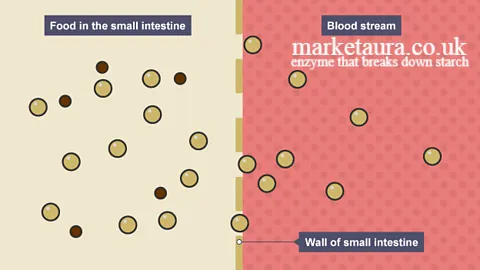
- Glucose is absorbed into the bloodstream.
This explains why the enzyme that breaks down starch is not just one enzyme working alone. Amylase starts the job, while several intestinal enzymes help finish it.
Where does starch digestion begin?
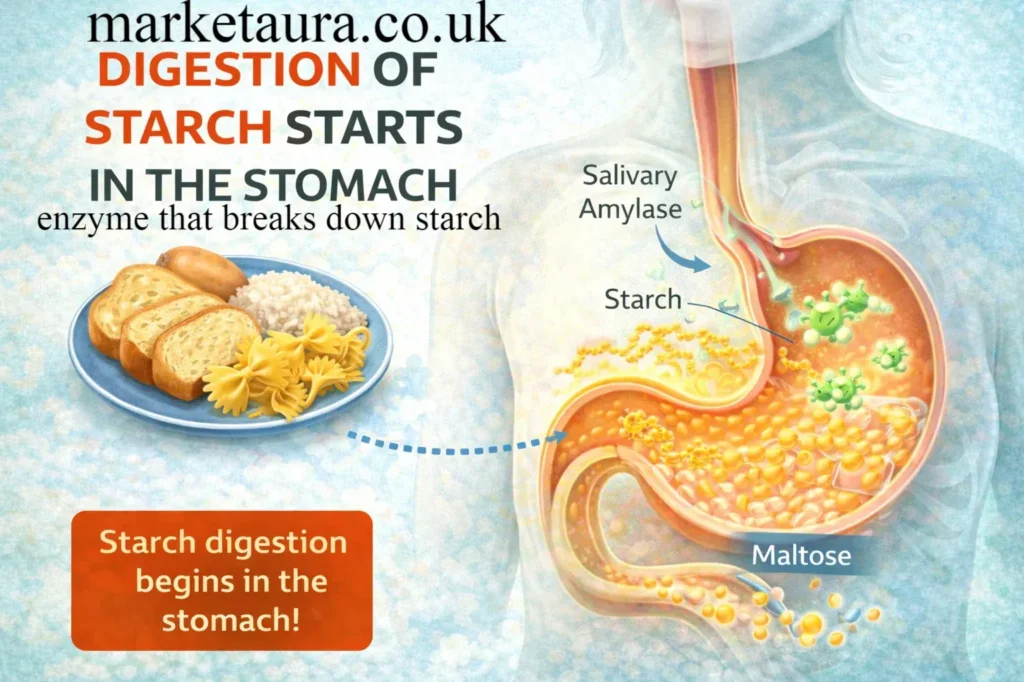
Starch digestion begins in your mouth.
When you chew bread, rice, potatoes, or another starchy food, saliva mixes with the food. Salivary glands release alpha amylase, also called ptyalin, into your saliva.
This enzyme begins hydrolyzing starch while you chew. The process can continue for some time after swallowing because amylase can remain associated with food particles and may retain activity during parts of digestion.
Your stomach is different. Its strongly acidic environment reduces amylase activity, although the complete picture is more complicated because amylase associated with food can sometimes remain active for part of the gastric process.
The major remaining starch digestion occurs in the small intestine.
How does the enzyme that breaks down starch work?
Starch mainly contains two types of glucose polymers called amylose and amylopectin.
Amylose has mostly linear chains. Amylopectin has a highly branched structure. These different structures influence how easily digestive enzymes can reach and break down the starch.
Alpha amylase attacks certain alpha glycosidic bonds inside these starch chains. This produces shorter carbohydrate fragments.
The process can be simplified like this: source: Amano Enzyme Inc.
Starch → smaller carbohydrate fragments → maltose and related sugars → glucose
The final conversion to glucose requires enzymes located along the surface of the small intestine. These include maltase glucoamylase and sucrase isomaltase.
Your intestinal cells then absorb glucose and transport it into the bloodstream.
Why does cooking affect starch digestion?
Cooking can make starch easier for digestive enzymes to access.
Raw starch has a semi crystalline structure that can resist enzyme activity. Heating starch with water causes a process called gelatinization. This changes the structure of the starch and can make it considerably more accessible to alpha amylase.
That is one reason cooked potatoes, rice, grains, and other starchy foods can be digested differently from their raw forms.
However, cooking is not the only factor.
Starch digestion can also depend on:
- The physical structure of the food
- The amount of amylose
- The amount of amylopectin
- Food processing
- Cooking temperature
- Cooling and storage
- Protein and fat surrounding the starch
- The presence of plant cell walls
- The amount of resistant starch
Research shows that the structure of the food matrix can strongly influence how easily alpha amylase reaches starch.
What happens to starch in the small intestine?
The small intestine is where most carbohydrate digestion and absorption takes place.
When partially digested food enters the duodenum, the pancreas releases pancreatic amylase. This enzyme continues breaking starch into smaller carbohydrates.
The intestinal surface then provides additional enzymes that complete carbohydrate digestion.
| Stage | Location | Main enzyme or process | Result |
|---|---|---|---|
| First stage | Mouth | Salivary amylase | Smaller starch fragments |
| Second stage | Stomach | Limited continued amylase activity | Partially digested starch |
| Third stage | Small intestine | Pancreatic amylase | Maltose, maltotriose, dextrins |
| Final stage | Intestinal surface | Maltase glucoamylase and sucrase isomaltase | Glucose |
| Absorption | Small intestine | Glucose transporters | Glucose enters circulation |
This coordinated process allows your body to extract energy from starch efficiently.
Does every starch digest at the same speed?
No. Different starches can digest at very different rates.
This is an important point when you think about the enzyme that breaks down starch. The presence of amylase does not mean every starchy food will be digested equally quickly.
Researchers describe starch as having different digestion behaviors, including rapidly digestible starch, slowly digestible starch, and resistant starch. Food structure and processing can affect how quickly enzymes gain access to starch.
For example, cooking can make starch more accessible. In contrast, certain structural arrangements can make starch harder for digestive enzymes to reach.
What is resistant starch?
Resistant starch is starch that escapes digestion in the small intestine.
Instead of being completely broken down and absorbed there, some resistant starch reaches the large intestine. Gut microorganisms can then ferment it and produce short chain fatty acids.
Research continues to investigate how resistant starch may influence gut health, glucose regulation, and metabolic health.
Can amylase affect blood sugar?
Yes, starch digestion can influence the rise in blood glucose after eating.
When amylase and other carbohydrate enzymes rapidly convert digestible starch into glucose, glucose can become available for absorption more quickly. However, your actual blood glucose response depends on many factors.
These include:
- The type of starch
- Portion size
- Food preparation
- Fiber content
- Protein content
- Fat content
- Food structure
- Your individual metabolism
- The overall meal
Scientific reviews emphasize that foods containing similar amounts of starch can produce substantially different glucose and insulin responses because their digestion rates differ.
This is why you should not judge a starchy food only by its total carbohydrate content.
What is the difference between amylase and maltase?
Amylase and maltase both participate in carbohydrate digestion, but they perform different jobs.
Amylase begins the breakdown of large starch molecules.
Maltase helps break maltose into glucose molecules.
You can think of amylase as an enzyme that starts dismantling a large structure. Maltase helps finish one part of that process.
The digestive system uses several enzymes because starch digestion is a multistep process rather than a single chemical reaction.
Is amylase found only in humans?
No. Amylase occurs across many organisms, including animals, plants, and microorganisms.
Human digestion mainly involves alpha amylase. Other forms of amylase have different biological roles and occur in different organisms.
Amylase also has major applications outside human digestion. Food manufacturers, breweries, bakeries, and biotechnology companies use amylase enzymes to modify starch and produce useful sugars and other ingredients.
This makes amylase important not only in human biology but also in food science and industrial biotechnology.
What does research say about salivary amylase?
Recent research has expanded interest in salivary amylase beyond simple digestion.
A 2025 review examined possible relationships between salivary alpha amylase, glucose regulation, insulin responses, and appetite. However, the researchers emphasized that much of this evidence remains correlational and that more research is needed before drawing firm conclusions about cause and effect.
This is a useful reminder that digestive enzymes can have complex biological relationships. A single enzyme should not be viewed as the sole explanation for changes in blood sugar, appetite, or metabolic health.
What are the key facts about the enzyme that breaks down starch?
Here are the most important points to remember:
- Amylase is the main enzyme that breaks down starch.
- Salivary amylase begins starch digestion in your mouth.
- Pancreatic amylase continues the process in the small intestine.
- Amylase produces smaller carbohydrates rather than converting all starch directly into glucose.
- Intestinal enzymes complete the conversion to absorbable glucose.
- Cooking can increase starch accessibility to digestive enzymes.
- Food structure can slow or accelerate starch digestion.
- Resistant starch can escape digestion in the small intestine.
- Starch digestion can influence post meal blood glucose levels.
- Amylase is also widely used in food and biotechnology industries.
Frequently Asked Questions
What is the enzyme that breaks down starch?
Amylase is the main enzyme that breaks down starch in humans. Salivary amylase starts the process in the mouth, while pancreatic amylase continues it in the small intestine.
Does amylase break down starch into glucose?
Not directly in one step. Amylase first produces smaller carbohydrates such as maltose, maltotriose, and dextrins. Other intestinal enzymes then help produce glucose.
Where does starch digestion begin?
Starch digestion begins in the mouth when salivary amylase mixes with food during chewing.
What enzyme breaks down starch in the small intestine?
Pancreatic alpha amylase is the major enzyme that continues starch digestion in the small intestine.
What happens to starch that is not digested?
Some starch can reach the large intestine as resistant starch. Gut microorganisms can ferment it and produce short chain fatty acids.
Does cooking make starch easier to digest?
Often, yes. Heating starch with water can gelatinize its structure and make it more accessible to digestive enzymes.
What is the difference between amylase and maltase?
Amylase breaks large starch molecules into smaller carbohydrates. Maltase helps break maltose into glucose.
Why is starch digestion important?
Starch digestion allows your body to convert complex carbohydrates into smaller molecules that can eventually be absorbed and used as energy.
Can food structure affect starch digestion?
Yes. The physical structure of food can limit enzyme access to starch and change how quickly digestion occurs.
Is amylase used outside the human body?
Yes. Amylase is widely used in food processing, baking, brewing, and biotechnology because it can modify starch into smaller carbohydrate molecules.
Conclusion
The enzyme that breaks down starch is primarily amylase, with salivary amylase starting the process in your mouth and pancreatic amylase continuing it in your small intestine. Other intestinal enzymes then complete the conversion of smaller carbohydrates into glucose.
Starch digestion is more complex than simply eating carbohydrates and producing glucose. Food structure, cooking, resistant starch, and the activity of several digestive enzymes can all affect how quickly starch becomes available to your body.
The next time you eat rice, bread, potatoes, or another starchy food, remember that a sophisticated enzyme system is already working from the moment you start chewing.
About the Author: Awais khan The author writes clear, research focused health and nutrition content designed to make complex biological topics simple, practical, and easy to understand. Each article focuses on accurate information, reader friendly explanations, and evidence based insights.
email: johanharwen@314gmail.com
Author Name: Awais khan