
Introduction
Want to see what effective WordPress SEO actually looks like? The best way to understand SEO is to study real examples and see how small improvements can make a page easier for both search engines and readers to understand.
WordPress SEO examples can show you how to optimize titles, headings, URLs, images, internal links, content structure, and technical settings. They also help you understand what separates a well optimized WordPress page from one that struggles to attract organic traffic.
Whether you run a blog, business website, news site, affiliate website, or online store, the same basic principles apply. You need useful content, clear structure, strong search intent, and a technically healthy website.
In this guide, you will find practical WordPress SEO examples that you can copy, adapt, and improve for your own website. You will also learn about common mistakes, useful tools, important SEO elements, and ways to make your content more visible in traditional search and AI powered search experiences.
What Is WordPress SEO?
WordPress SEO means optimizing a WordPress website so search engines can crawl, understand, index, and rank its pages effectively.
In simple terms, WordPress SEO helps your website communicate clearly with search engines while giving visitors a better experience.
It includes several important areas:
- Keyword research
- Search intent
- Title optimization
- Meta descriptions
- Heading structure
- URL optimization
- Internal linking
- Image optimization
- Mobile usability
- Website speed
- Technical SEO
- Structured data
- Helpful content
- Local SEO
WordPress itself gives you a strong foundation, but installing WordPress alone does not guarantee high rankings.
Why Are WordPress SEO Examples Important?
Examples make SEO easier to understand because you can see how theory works on an actual page.
For example, imagine you want to target the keyword best running shoes for beginners.
A weak page title might be: marketaura
Running Shoes
A stronger SEO title could be:
Best Running Shoes for Beginners: Top Picks and Tips
The second title gives searchers more information and matches a more specific search intent.
A useful WordPress SEO example should answer three questions:
- What does the searcher want?
- What information does the page provide?
- How can search engines understand the page quickly?
WordPress SEO Examples for Titles
Your title is one of the first things users see in search results.
A strong title should describe the page accurately while giving users a reason to click.
| Target Keyword | Weak Title | Better SEO Title |
|---|---|---|
| WordPress SEO | WordPress SEO | WordPress SEO Guide: Easy Tips for Better Rankings |
| SEO tools | SEO Tools | Best SEO Tools for Beginners: Features and Tips |
| WordPress speed | Website Speed | WordPress Speed Optimization: Simple Ways to Load Faster |
| Local SEO | Local SEO | Local SEO for Small Businesses: A Practical Guide |
| WordPress plugins | Plugins | Best WordPress SEO Plugins for Better Search Visibility |
Avoid making every title identical to the keyword.
Instead, add useful context and match the reason behind the search. marketaura
WordPress SEO Examples for URLs
A clean URL helps users and search engines understand what a page covers.
For example:
Poor URL
example.com/page123
Better URL
example.com/wordpress-seo-examples
The second version clearly describes the topic.
Keep your URLs: marketaura
- Short
- Descriptive
- Easy to read
- Relevant to the page
- Focused on the main topic
Avoid adding unnecessary numbers, random characters, or extremely long URL structures.
WordPress SEO Examples for Headings
Headings organize your content and make long articles easier to scan.
A strong structure might look like this:
H1: WordPress SEO Examples
H2: What Is WordPress SEO?
H2: WordPress SEO Examples for Beginners
H3: Title Optimization
H3: URL Optimization
H3: Internal Linking
H2: Common WordPress SEO Mistakes
H2: WordPress SEO Checklist
Use one clear H1 for the primary page topic.
Then use H2 and H3 headings to organize supporting topics logically.
Do not add headings simply to include keywords. Every heading should help the reader understand what comes next.
WordPress SEO Examples for Meta Descriptions
A meta description gives searchers a quick summary of your page.
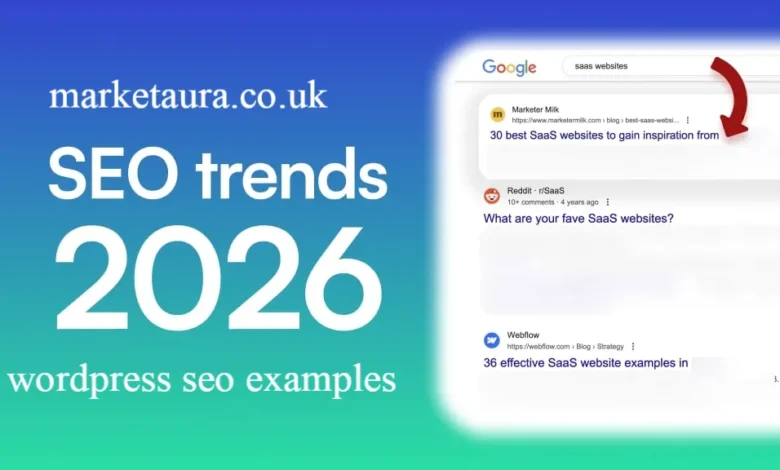
Source: Marketer Milk
For example, suppose your primary keyword is WordPress SEO guide.
A weak description could be:
WordPress SEO guide with SEO information.
A better version could be:
Learn how to optimize WordPress SEO with practical tips for titles, content, images, speed, internal links, and better search visibility.
The second description explains the benefit and gives users a clearer reason to visit the page.
Remember that search engines may sometimes generate their own search snippet instead of displaying your exact meta description.
WordPress SEO Examples for Internal Links
Internal linking connects one page on your website to another relevant page.
Imagine you have an article about WordPress SEO.
You could naturally connect it to pages covering:
- Keyword research
- Technical SEO
- On page SEO
- Schema markup
- Website speed
- Content optimization
- Image SEO
Good internal links help readers discover related information.
They can also help search engines understand relationships between pages.
A useful internal linking strategy should focus on relevance rather than adding links simply for quantity.
WordPress SEO Examples for Images
Images can improve engagement, but poorly optimized images can also slow down your website.
For example, an image file named:
IMG00045.jpg
does not tell much about the image.
A more descriptive filename might be:
wordpress-seo-dashboard.jpg
You should also write useful alternative text when the image needs it.
For example:
Alt text: WordPress SEO settings dashboard
Do not fill alt text with unnecessary keywords. Describe the image naturally and accurately.
Source: Elementor
WordPress SEO Examples for Content Structure

A well structured article should answer the main question early.
For example, if someone searches:
How do I improve WordPress SEO?
Start with a direct answer.
You can say:
You can improve WordPress SEO by optimizing your content, titles, URLs, images, internal links, mobile experience, website speed, and technical settings.
Then explain each part in more detail.
This question first approach works well for users because they do not need to read several paragraphs before finding the answer.
It also supports answer focused search experiences.
WordPress SEO Examples for Featured Answers
Searchers often want quick answers.
Suppose the question is:
Does WordPress help with SEO?
A concise answer could be:
Yes. WordPress provides many SEO friendly features, but you still need to optimize content, technical settings, performance, and website structure.
After giving the direct answer, expand the topic.
This structure gives readers the information they need quickly while still allowing you to provide deeper details.
WordPress SEO Examples for Local Businesses
If you run a local business, your SEO strategy should include location information.
For example, instead of targeting only:
plumber
you could target:
plumber in Hyderabad
Your page can include:
- Business name
- Address
- Phone number
- Opening hours
- Services
- Service areas
- Customer questions
- Local business information
Consistency matters.
Your business information should remain accurate across your website and relevant business profiles.
WordPress SEO Examples for Ecommerce Websites
WordPress ecommerce websites often use WooCommerce.
Suppose you sell running shoes.
Instead of creating a thin product page with only the product name and price, provide useful information such as:
- Product specifications
- Sizes
- Materials
- Features
- Usage recommendations
- Care instructions
- Customer questions
- Product images
A category page can also target broader searches.
For example:
Running Shoes
Then individual products can target specific product searches.
This creates a logical content structure.
WordPress SEO Examples for Blog Posts
A strong blog post should match the searcher’s intent.
Consider the keyword:
how to speed up WordPress
The reader probably wants practical instructions.
Your article could include:
- Identify slow pages
- Compress large images
- Remove unnecessary plugins
- Improve caching
- Reduce unnecessary scripts
- Check hosting performance
- Test the website again
The important point is that the article should solve the problem rather than simply mention the keyword repeatedly.
WordPress SEO Examples for Technical SEO
Technical SEO helps search engines access and understand your website.
Important areas include:
| Technical Element | What to Check |
|---|---|
| Mobile usability | Pages work properly on phones |
| Indexing | Important pages can appear in search |
| Sitemap | Search engines can discover important URLs |
| Robots settings | Crawlers are not accidentally blocked |
| HTTPS | Website uses a secure connection |
| Canonical URLs | Duplicate URL problems are controlled |
| Page speed | Pages load efficiently |
| Structured data | Relevant content is clearly identified |
A technically strong website gives your content a better foundation.
Common WordPress SEO Mistakes
Many WordPress websites lose opportunities because of simple mistakes.
Keyword Stuffing
Repeating the same keyword unnaturally can make content difficult to read.
Use related terms naturally and focus on answering the searcher’s question.
Thin Content
A page that provides little useful information may struggle to satisfy users.
Focus on depth, usefulness, examples, and clear explanations.
Poor Website Structure
If important pages are buried several clicks away, both users and search engines may have difficulty discovering them.
Create a logical structure with categories and relevant internal links.
Ignoring Mobile Users
A large share of internet activity happens on mobile devices.
Your website should remain easy to read and use on smaller screens.
Installing Too Many Plugins
Plugins can provide useful functionality, but unnecessary plugins can increase maintenance requirements and potentially affect performance.
Install only what your website genuinely needs.
WordPress SEO Checklist
Use this simple checklist before publishing a WordPress page.
- Choose one primary keyword
- Understand search intent
- Create a useful title
- Write an attractive meta description
- Use a clean URL
- Add one clear H1
- Organize content with H2 and H3 headings
- Answer important questions early
- Add relevant internal links
- Optimize images
- Check mobile usability
- Improve page performance
- Review indexing settings
- Add relevant structured data
- Proofread the article
- Remove unnecessary keyword repetition
WordPress SEO Statistics and Research Insights
SEO performance depends on many factors, so no single statistic guarantees rankings.
Google has repeatedly emphasized useful, reliable, people first content rather than content created simply to manipulate search rankings.
Core Web Vitals also provide measurable signals related to loading performance, responsiveness, and visual stability.
From a practical perspective, this means your WordPress SEO strategy should not focus only on keywords.
You should combine:
Useful content + strong technical foundations + good user experience + clear website structure
That combination creates a more sustainable SEO strategy.
Expert Tip for Better WordPress SEO
One of the most useful SEO habits is to review your page from the perspective of the person searching.
Before publishing, ask:
If I searched this exact question, would this page give me the answer faster and better than most competing pages?
If the answer is no, improve the page.
Add original examples, clearer explanations, useful data, practical steps, images, tables, or expert insights where appropriate.
Do not add words simply to make an article longer.
WordPress SEO Tools You Can Use
Several well known tools can help you improve your WordPress SEO workflow.
Useful options include:
- Google Search Console
- Google Analytics
- Google PageSpeed Insights
- Ahrefs
- Semrush
- Yoast SEO
- Rank Math
- Google Trends
Each tool has a different purpose.
For example, Google Search Console helps you understand search performance and indexing. Ahrefs and Semrush can support keyword and competitor research. Yoast SEO and Rank Math provide WordPress focused optimization features.
Frequently Asked Questions
What is a good WordPress SEO example?
A good example is a page with a clear keyword focused title, clean URL, useful content, logical headings, optimized images, internal links, and strong search intent alignment.
Is WordPress good for SEO?
Yes. WordPress provides a strong foundation for SEO, but you still need to optimize content, technical settings, performance, and website structure.
What is the most important WordPress SEO factor?
There is no single factor that guarantees rankings. Helpful content, search intent, technical accessibility, website structure, and overall user experience all matter.
Do WordPress SEO plugins improve rankings?
SEO plugins can make optimization easier by providing useful settings and recommendations. However, installing a plugin alone does not guarantee higher rankings.
How many keywords should I use in a WordPress article?
Focus on one main topic and use related keywords naturally. Avoid forcing a specific keyword percentage into every paragraph.
Should I use keywords in WordPress URLs?
Yes, when appropriate. A short descriptive URL can help users and search engines understand the page topic.
How can I make WordPress content AEO friendly?
Answer important questions directly, place concise answers near the beginning of relevant sections, use clear headings, and provide structured information.
How can WordPress SEO support GEO?
Create original and trustworthy content with clear entities, specific facts, expert insights, useful examples, and consistent information. This makes your content easier for search systems and AI experiences to understand.
Are internal links important for WordPress SEO?
Yes. Relevant internal links help users discover related content and help search engines understand the relationship between pages on your website.
Conclusion
These WordPress SEO examples show that successful optimization involves much more than adding keywords to a page.
You need to understand search intent, create helpful content, write attractive titles, use clean URLs, structure your headings, optimize images, build relevant internal links, and maintain a technically healthy website.
The strongest WordPress SEO strategy puts the reader first while making the page easy for search engines to understand.
Start with one important page on your website. Improve its title, structure, content, internal links, images, and technical elements. Then measure the results and continue improving.
If you consistently apply these WordPress SEO examples, you can build a website that is easier to understand, easier to navigate, and better prepared for modern search.
Author Bio: Johan Harwen is a digital content and SEO writer who focuses on practical search optimization, keyword research, WordPress, and content strategy. His goal is to explain complex SEO topics in a simple, useful, and reader friendly way.
Email: johanharwen@314gmail.com
Author Name: Johan Harwen