

Introduction
You publish a great article. You wait. Nothing happens. No traffic. No rankings. Sound familiar? The problem is not your writing. The problem is your keyword research tips strategy and on-page SEO execution.
Most bloggers and marketers skip proper keyword research tips before writing. They optimize after the fact. They wonder why Google ignores their content. The reality is simple: on-page SEO starts before you write a single word.
In this article, you will learn exactly what on-page SEO is, see real examples of each element, and get a ready-to-use checklist. Whether you are a complete beginner or improving your existing content, these keyword research tips and on-page SEO examples will give you everything you need to start ranking. Let us get into it.
What Is On-Page SEO?
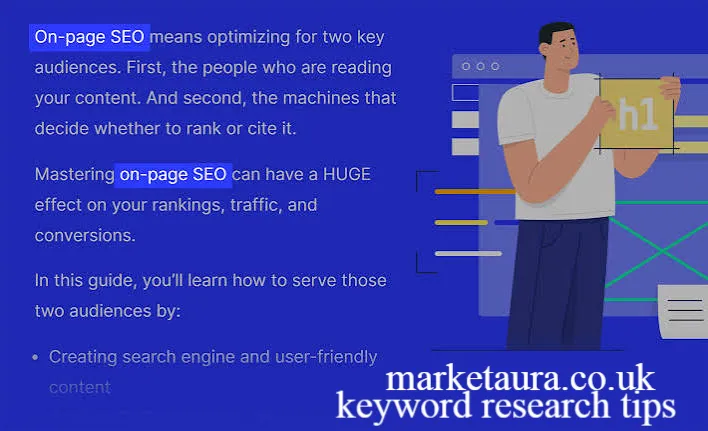
On-page SEO refers to all the optimizations you make directly on your webpage to improve its search engine ranking. It includes everything Google reads, crawls, and evaluates on your page. It covers your content, headings, meta tags, images, and internal links.
Unlike off-page SEO, which depends on external signals like backlinks, on-page SEO is entirely within your control. That makes it your most powerful starting point. You do not need anyone else’s help. You just need to know what to do and how to do it correctly.
Why Is On-Page SEO Important?
Google uses on-page signals to understand what your page is about. If your page sends mixed or unclear signals, it struggles to rank. Clear and consistent on-page SEO tells Google exactly what your content covers and who it serves.
According to SEMrush, pages with properly optimized on-page elements rank significantly higher than those without. On-page SEO also improves user experience. Clear headings, fast load times, and relevant content reduce bounce rates. Lower bounce rates signal quality to Google and further improve rankings.
Simply put, on-page SEO is the foundation. Without it, even the best keyword research tips in the world will not produce results.
Real On-Page SEO Examples You Can Copy Today
Optimized Title Tag Example
Your title tag is the most powerful on-page element. It tells Google the core topic of your page. It also tells users whether to click your result.
Bad title tag: “SEO Tips for Your Website Page Optimization Guide”
Optimized title tag: “Keyword Research Tips: 10 Proven On-Page SEO Examples That Rank”
The optimized version includes the primary keyword near the front. It is under 60 characters. It uses a number for credibility and a power word to encourage clicks. Always write title tags for people first, then for search engines.
Meta Description Example
Your meta description does not directly affect ranking, but it dramatically affects click-through rate. A higher click-through rate signals quality to Google and indirectly boosts rankings.
Bad meta description: “Learn about SEO. This article has tips and examples for you.”
Optimized meta description: “Discover real keyword research tips and on-page SEO examples that work. Copy our actionable checklist and start ranking today. No fluff, just results.”
Notice how the optimized version includes the primary keyword naturally, promises a specific benefit, and uses action-oriented language.
Header Tags Example
Headers organize your content and signal structure to Google. Use one H1 tag per page containing your primary keyword. Use H2 tags for main sections. Use H3 tags for subsections.
Wrong approach: All content in one block with no headings
Right approach: H1: Keyword Research Tips for On-Page SEO Success H2: What Is On-Page SEO? H2: Real On-Page SEO Examples H3: Title Tag Example H3: Meta Description Example
This structure helps Google understand your content hierarchy. It also makes your article skimmable for readers.
Image ALT Text Example
Every image on your page needs descriptive ALT text. ALT text helps visually impaired users and helps Google understand your images. Many websites ignore this simple ranking signal.
Bad ALT text: “image1.jpg” or leaving it blank
Optimized ALT text: “keyword research tips checklist on whiteboard” source: detailed.com
The optimized version describes exactly what the image shows and naturally includes a relevant keyword. Do not stuff keywords into ALT text. Just describe the image accurately and relevantly.
Internal Linking Example
Internal links help Google discover more of your content. They distribute authority across your pages. They also keep users on your site longer, which improves engagement signals.
Bad internal linking: No links, or random links with generic anchor text like “click here”
Optimized internal linking: Linking to related articles using descriptive anchor text like “see our complete guide to long-tail keyword strategy”
The optimized version tells Google exactly what the linked page is about. It adds value to the reader by pointing to genuinely related content. Aim for three to five internal links per article minimum.
How Do Beginners Improve On-Page SEO?
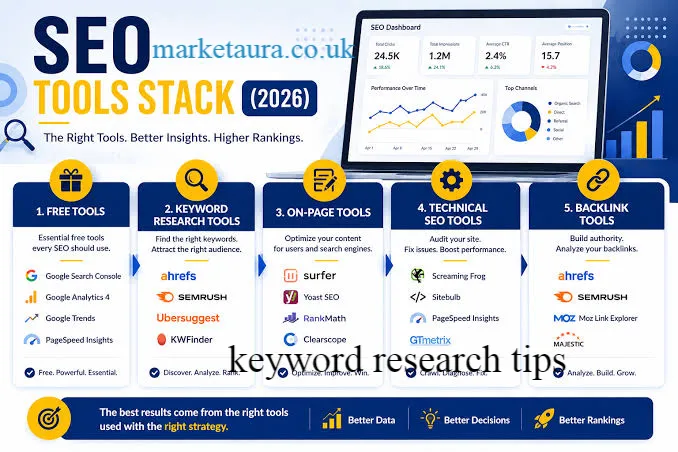
Start with keyword research before writing anything. Use tools like Google Keyword Planner, Ubersuggest, or Ahrefs. Find keywords with search volume and manageable competition. Choose one primary keyword and two to three secondary keywords per page.
Next, place your primary keyword in your title tag, H1, first paragraph, meta description, and at least two subheadings. Use secondary keywords naturally throughout the body. Write for people, not just for Google. Google understands context and rewards genuinely helpful content.
Compress your images before uploading. Add descriptive ALT text. Link to at least three internal pages. Use short paragraphs and clear subheadings. These five steps alone will put you ahead of most competitors.
On-Page SEO Actionable Checklist
Use this checklist every time you publish or update content:
Before Writing:
- Research primary keyword and confirm search volume source: Ahrefs
- Identify three related secondary keywords
- Check top-ranking competitors for content gaps
During Writing:
- Include primary keyword in the first 100 words
- Use primary keyword in H1 heading
- Use secondary keywords naturally in H2 and H3 headings
- Write short paragraphs of three to five sentences
- Add at least three internal links with descriptive anchor text
Before Publishing:
- Write title tag under 60 characters including primary keyword
- Write meta description under 160 characters with clear benefit
- Add descriptive ALT text to every image
- Check page load speed using PageSpeed Insights
- Verify mobile responsiveness on your phone
After Publishing:
- Submit URL to Google Search Console
- Share on at least two channels (social media, email)
- Monitor rankings weekly for 30 days
Conclusion
On-page SEO is not complicated. But it requires deliberate effort and consistent execution. The keyword research tips and examples in this article give you a clear starting point. The checklist gives you a repeatable process.
Your competitors are probably skipping half of these steps. That is your advantage. Apply these keyword research tips consistently and you will start seeing rankings improve within weeks.
Which on-page SEO element have you been neglecting most? Share your answer in the comments. Or bookmark this checklist and run your top three pages through it today. Small improvements compound into major ranking gains over time.
FAQs
1. What are the most important on-page SEO elements? Title tag, meta description, H1 heading, body content quality, image ALT text, and internal linking are the most critical elements. Master these six and you are ahead of most websites.
2. How often should I update my on-page SEO? Review your top-performing pages every three to six months. Update content, refresh keywords, and improve any weak elements. Regular updates signal freshness to Google.
3. Can I use the same keyword on multiple pages? Avoid targeting the same keyword on multiple pages. This creates keyword cannibalization, where your pages compete against each other. Target distinct keywords on each page.
4. How long should my content be for good on-page SEO? Length depends on the topic. Informational content typically performs well at 1,000 to 2,500 words. The key is covering the topic completely, not hitting a word count.
5. Does on-page SEO work without backlinks? Yes, especially for low-competition keywords. Strong on-page SEO can rank pages without any backlinks. As competition increases, backlinks become more necessary.
6. What keyword density should I aim for? Aim for natural usage. There is no magic percentage. If you mention your primary keyword once every 200 to 300 words, that is typically appropriate. Stuffing keywords hurts rankings.
7. How do I find secondary keywords for my article? Look at Google’s “People Also Ask” box and related searches at the bottom of search results. Tools like Ahrefs, SEMrush, and Ubersuggest also suggest related keywords.
8. What is the difference between on-page and technical SEO? On-page SEO focuses on content and visible elements. Technical SEO focuses on website infrastructure including page speed, crawlability, and structured data.
9. Should my URL include my target keyword? Yes. Keep URLs short, descriptive, and keyword-focused. Avoid dates and numbers. A URL like yoursite.com/keyword-research-tips performs better than yoursite.com/p=1234.
10. How quickly will on-page SEO improvements show results? Google typically processes changes within days to weeks. Ranking improvements usually appear within four to twelve weeks depending on competition and domain authority.
About the Author : Rachel Kim is a digital marketing strategist and SEO consultant with over ten years of experience helping businesses improve their search rankings. She specializes in content strategy, keyword research, and on-page optimization for small businesses and startups. Rachel believes SEO does not need to be complicated and writes to make it accessible for everyone. When she is not optimizing websites, she speaks at digital marketing conferences and teaches online SEO workshops.
email: johanharwen@314gmail.com
Author Name: Rachel Kim